

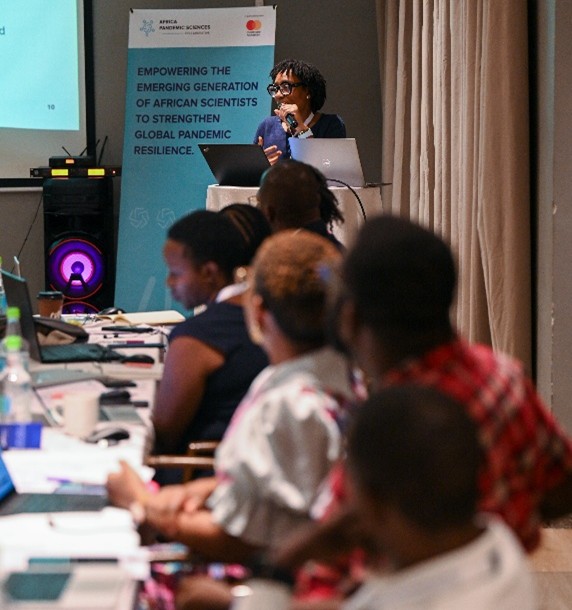
From 24th to 27th November 2025, the Africa Pandemic Sciences Collaborative (the Collaborative) organised a training workshop on Monitoring, Evaluation, Accountability, and Learning (MEAL) at the Radisson Blu Hotel in Lagos State, Nigeria. The workshop had 30 researchers and professionals in attendance, drawn from across several African countries and the University of Oxford, England.
 The Collaborative is a partnership between the Science for Africa Foundation (SFA Foundation), the Pandemic Sciences Institute (PSI) at the University of Oxford, and Mastercard Foundation. The workshop was organised to strengthen evidence generation activities across seven Epidemic and Pandemic Science Innovation and Leadership Networks (EPSILONs), through which the Collaborative works. The EPSILONs are aimed at strengthening African research and higher education institutions to enable them to conduct world-class, innovative research and translate findings into impactful, locally relevant solutions that contribute to shaping and strengthening pandemic resilience and, ultimately, the continent’s health ecosystem for the benefit of future generations.
Strengthening Health Systems Capacity in Africa for Pandemic Equity and Responsiveness (SHARPER), one of the seven EPSILONs, is a consortium of six partner institutions, including College of Medicine, University of Ibadan (CoMUI), University of Cape Town (UCT), Cameroon Bioethics Initiative (CAMBIN), Kamuzu University of Health Sciences (KUHES), Malawi, Afya Ahaki Institute, Uganda, and Tropical Institute for Community Health (TICH), Kenya. The CoMUI is the lead institution, with Prof. Ademola Ajuwon of the Department of Health Promotion and Education as the Principal Investigator. The hosting of the MEAL Workstream Onboarding workshop in Nigeria was both strategic and symbolic, underscoring the country’s leadership in reimaging Africa’s pandemic science ecosystem and its commitment to collaborative scientific advancement.

Delivering his opening remarks, the Provost of the College of Medicine, University of Ibadan, Professor Temidayo Ogundiran, emphasised the transformative potential of the collaboration among the partners. He urged participating teams to embrace the research process with commitment, integrity, and accountability, noting that the outcomes of their work will shape the future of African health systems, scientific leadership, and policy direction. He also reaffirmed the institution’s support for SHARPER and its dedication to sustaining excellence in global health research.
Over the four-day workshop, participants explored the Collaborative’s MEAL frameworks, reporting expectations, and progress-tracking tools required for effective project delivery. Sessions delved into operationalising research indicators, strengthening documentation systems, and adopting impact-driven storytelling approaches to influence pandemic responsiveness policies across Africa. The discussions focused on how to translate scientific research into measurable public benefit and long-term health resilience in Africa.
During one of the sessions, the SHARPER team presented its Theory of Change, outlining how the project aims to support early- and mid-career researchers through fellowships, catalyst grants, and interdisciplinary mentorship. SHARPER is rooted in African philosophies of community, personhood (Ubuntu), and equity, and seeks to improve health systems that ensure post-trial access and benefits, strengthen the continent’s pandemic readiness and responsiveness, and develop the capacity of young scholars to contribute to the improvement of the research ecosystem. These goals will be achieved through assessment of the legal, scientific, regulatory, and ethical dimensions of pandemic research in Africa and award of capacity development grants to young researchers.
The momentum from this workshop marks the beginning of an afro-centric impact journey. As the SHARPER project now moves forward, the coming months will reveal how research, grounded in African experience and powered by African expertise, can shape a future where pandemic responsiveness is not a crisis response but a sustained culture of equity, readiness, and scientific stewardship.
Click Here to read more about the Collaborative and the MEAL workshop.